Thứ Năm, 1 tháng 6, 2017

Historical Linguistics 1995 Volume 2 (Series IV Current Issues in Linguistic Theory 162)

The Twelfth International Conference on Historical Linguistics, which is the major forum for the presentation of work in progress in the field of diachronic linguistics, took place at the University of Manchester in August 1995.


The quality and breadth of the abstracts submitted for the general programme was such that four parallel sessions were needed throughout the conference. The present volume contains selected papers which deal with the Germanic languages.


A companion volume, edited by J.C. Smith and Delia Bentley, contains papers on general problems in historical linguistics and studies of non-Germanic languages. The conference reflected the current health of diachronic linguistics. There were more papers and more participants than at past conferences, and the discussion covered a broader range of languages than hitherto.


Sometimes it has been possible to isolate a particular preoccupation which has dominated much of the conference; but the overall impression to be gained from the Manchester meeting was one of stimulating diversity — the discipline appears to be moving forward on many fronts simultaneously, yet without losing focus. This stimulating diversity is well reflected in this important collection.


Historical Linguistics 1995 Volume 1 (Series IV Current Issues in Linguistic Theory 161)

This volume contains papers on general issues of language change, as well as specific studies of non-Germanic languages, including Romance, Slavonic, Japanese, Australian languages, and early Indo-European.


A second volume, edited by Richard M. Hogg and Linda van Bergen, contains papers on Germanic.
 

Historical Linguistics 1989 (Series IV Current Issues in Linguistic Theory 106)

The present volume contains revised versions of selected papers from the general sessions of ICHL 9. The 34 papers cover topics from the full range of contemporary historical linguistic scholarship.


The papers address issues of language change in a large variety of languages and language families, both Indo-European and non-Indo-European: students of Germanic linguistics will likely find the volume to be of particular interest, as more than a dozen contributions deal with developments in Afrikaans, Dutch, English, German and Icelandic. The volume includes an index of names and languages.


Download:  http://huyhuu.com/news/18754/Historical-Linguistics-1989-(Series-IV-Current-Issues-in-Linguistic-Theory-106)

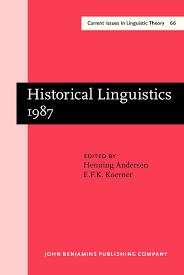
Historical Linguistics 1987 (Series IV Current Issues in Linguistic Theory 66)

The volume contains 37 papers originally presented at the 8th International Conference on Historical Linguistics in Lille, France. The papers bring historical data to bear on issues in theoretical linguistics, both descriptive and diachronic or deal with specific questions in the history of individual languages.


The theoretical issues range from phonology over morphology and syntax to the lexicon, as well as questions of historical dialectology, language contact, the theory of linguistic change, and problems of comparative reconstruction. The languages discussed are Finno-Ugric and Indo-European, most of the papers dealing with Germanic and Romance languages (especially English and French), but some being devoted to Greek, Celtic, Slavic, and Hittite.


Explanation in Historical Linguistics (Series IV Current Issues in Linguistic Theory 84)

This is the first of two volumes deriving from papers presented at the Nineteenth Annual UVM Linguistics Symposium held in Milwaukee in April 1990.


The contributions in this volume investigate the general question of what constitutes an explanation of diachronic change, and illustrate their proposals in the context of various specific problems in historical linguistics. The present volume also includes a solicited paper by Eric P. Hamp (“On remote reconstruction”) that addresses the validity of distant reconstructions like those of Nostratic and Proto-World.

English Historical Linguistics 2010 (Series IV Current Issues in Linguistic Theory 325)

The volume brings together seventeen peer-reviewed, revised papers originally presented at the 16th International Conference on English Historical Linguistics (ICEHL 16), held in August 2010 at the University of Pécs, Hungary.


This selection aims to show how theoretical and empirical approaches can be combined in the historical investigation of the English language, what insights and exact information can be obtained about language change in the history of English with the help of tools like historical corpora or with inter- and transdisciplinary methods.


The volume is arranged around five thematic headings. The first discusses dialects and regional variation from the viewpoint of contact linguistics and phonological, morphological, and lexical change. The second has syntactic variation and grammaticalization as its focus. Papers on grammatical changes in nominal and pronominal constructions are presented in part three. The integration of loanwords in Middle English is discussed in part four, and the last investigates communicative intentions in historical discourse.


The volume should appeal to linguists interested in historical aspects of dialect and discourse studies, historical pragmatics, contact linguistics, grammaticalization theory, corpus linguistics, and of course language change.


English Historical Linguistics 2008 Volume II (Series IV Current Issues in Linguistic Theory 324)

The fifteen papers selected for Volume II of English Historical Linguistics 2008 have a different emphasis than those in Volume I (CILT 314, Lenker et al. 2010). Nine concentrate on the development of the English vocabulary and six on historical text linguistics, including the development of text-types and of politeness strategies.


Of those in the former group, three have their emphasis on etymology, three on semantic fields, and three on word-formation, although some cover more than one of these areas. The topics include: the treatment of etymological problems in the OED; deverbal derivations formed from native verbs and from loan-verbs; the role of metaphor and metonymy in the evolution of word-fields.


The field of historical text linguistics is introduced by a general survey, which is followed by more specific studies focussing on 15th-century legal and administrative texts from Scotland, on early 15th-century women’s mystical writings, on medical recipes from the 16th to the 18th centuries and on pauper letters from 18th-century Essex.


The book should appeal to scholars interested in English etymology, the history of semantic fields and of word-formation, as well as in historical text linguistics, politeness strategies and standardization. It provides not only theoretical considerations but also a wealth of case studies.